Choosing an Optical Glass Lens in 2026 starts with the image you need, not the longest specification sheet. A microscope objective, a laser focusing assembly, and a compact camera lens face different demands. Define the wavelength range, focal length, aperture, field of view, and working temperature before comparing materials. These details affect transmission, focus, and image quality. A lens that performs well under white laboratory light may behave differently at a narrow laser wavelength.
Optical designer Rudolf Kingslake’s lens-design teaching offers a useful reminder: “Lens performance is a balance between design goals and practical limits.” Treat that as guidance, not a substitute for testing. Compare refractive index and dispersion, then check surface quality, coating range, dimensional tolerances, and mounting requirements. Ask for a material datasheet and, where the application is critical, measured performance across the intended wavelengths. A drawing may look precise. The assembled system can still shift focus when its temperature changes.
Small details matter. A scratched edge or a coating outside its useful range can undermine an otherwise suitable lens. In 2026, supplier traceability and clear inspection records also help teams compare products consistently. Avoid choosing by price or a single headline figure. Match the lens to its actual operating conditions, and verify the result on a bench. One limitation remains: specifications cannot predict every assembly effect. Check the finished system, not just the catalog.
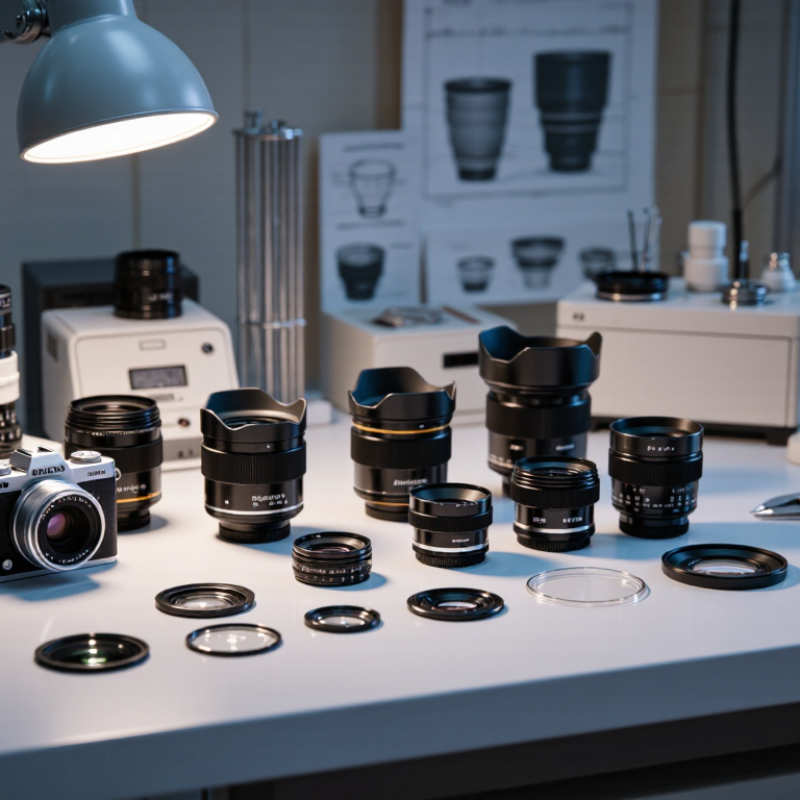
Define the task before comparing optical glass. A lens for a handheld camera may prioritize compactness and edge-to-edge image quality. A machine-vision lens may need stable magnification and low distortion. Write down the working distance, field of view, sensor size, wavelength range, and operating temperature. Small details matter. A lens used under red illumination may perform differently across the visible spectrum.
CIPA’s 2024 camera shipment statistics record approximately 8.49 million digital cameras shipped worldwide. This market figure does not set lens specifications, but it illustrates the range of imaging systems a lens may serve. For your application, specify focal length, aperture, acceptable distortion, and resolution at the sensor plane. Match resolution targets to the sensor’s pixel pitch, then check performance across the full field—not only at the center. ISO 12233 provides standardized methods for measuring electronic still-image resolution.
Set tolerances that reflect real use. If the lens faces vibration, dust, or temperature shifts, include those conditions in testing. ISO 10110-7 provides a system for specifying surface imperfections on optical elements. I have seen teams define image quality carefully, then overlook working distance; that can force a costly redesign. It is an easy assumption to miss. Include mounting limits and available space in the requirement sheet, too.
Choosing optical glass starts with the job, not the highest refractive index. Crown glasses usually offer lower dispersion and steadier color; flint glasses bend light more strongly but can separate colors more. Industry optical-glass catalog tables report common crown glass near nᵈ = 1.517 and Vᵈ = 64, while dense flint examples reach about nᵈ = 1.785 and Vᵈ = 26. Here, nᵈ describes refractive index at the yellow d-line, and Vᵈ indicates dispersion. Higher Vᵈ generally means less color spread. ISO 12123:2018 provides a framework for specifying raw optical glass, so compare measured catalog values rather than relying on glass-family labels alone. Small differences matter.
Tips: For a compact lens, a higher index may reduce curvature and thickness. Check dispersion too: a high-index flint can create visible color fringes near a bright window. For achromatic systems, pair glasses with contrasting dispersion, then verify the design across its full wavelength range. Real assemblies also face tolerances and temperature shifts. I would not choose from index alone; it is an easy shortcut, but not always a good one.
Compare representative refractive index and Abbe number across common optical glass families.
A higher refractive index can help achieve a given optical power with a thinner lens. The Abbe number indicates dispersion: a higher value generally means less color separation. These are representative values; exact properties vary by glass formulation and measurement wavelength.
Choosing optical glass lenses in 2026 means checking geometry before judging coatings. Match curvature, focal length, and thickness to the working distance and field of view. For an imaging lens, ask for measured distortion and modulation transfer function (MTF), not just a “sharp” rating. MTF shows how well fine detail survives from center to edge. Small edge blur can matter when reading tiny labels. That detail is easy to miss.
Coatings affect both transmission and ghost reflections. At normal incidence, an uncoated glass surface with a refractive index near 1.5 reflects about 4% of incoming light, based on the Fresnel equation. Ask for reflectance data across the wavelengths you actually use; a coating optimized for visible light may not suit near-infrared work. For sunglass applications, ISO 12312-1:2022 sets visible-transmittance categories: Category 3 allows 8%–18%, while Category 4 allows 3%–8% and is not intended for driving. Confirm the test method and wavelength range on any performance sheet. Numbers without conditions can mislead. I would also compare samples under the real light source, because laboratory values never tell the whole story.
Durability starts with the coating, not the sales description. Ask for test records covering abrasion, adhesion, humidity, and temperature cycling. ISO 9211 provides a framework for specifying optical coatings, while ISO 10110-7 helps define surface imperfections. These references make “high quality” more measurable. Small scratches matter. A lens may pass a visual check yet scatter light after repeated cleaning, so request inspection criteria and batch-level traceability.
Compatibility is equally practical. Match the glass’s refractive index and dispersion to the optical design, then verify clear aperture, diameter, thickness, and mount tolerances. Confirm the coating’s wavelength range and angle of incidence; a coating optimized for visible light may perform poorly in near-infrared use. ASTM D1003 describes haze measurement for transparent materials, a useful reference when stray light matters. Specify the test method, not just a target number. That detail is easy to miss.
Manufacturing quality depends on repeatable polishing and measurement. Request interferometric surface-form data, centration results, and edge-inspection records for the actual production lot. Photonics21’s 2024 Market Data and Industry Report estimates European photonics production at about €124 billion in 2022, illustrating the scale of the supply chain; scale alone, however, does not guarantee consistent lenses. A neat datasheet can still leave gaps. Ask who measured each tolerance, under what conditions, and whether the report follows the delivered lot.
| Category | Material or Check | Typical Data or Specification | What It Means for Selection | What to Verify |
|---|---|---|---|---|
| Material | Fused silica | Refractive index at the sodium d line (nd, 587.6 nm): approximately 1.458; Abbe number (Vd): approximately 67.8; thermal expansion: approximately 0.52 × 10⁻⁶/K. | Low thermal expansion makes it useful where temperature changes can affect focus or alignment. Its transmission depends on grade, wavelength, thickness, and surface condition. | Confirm the required wavelength range, material grade, homogeneity, and whether the lens is coated for the intended spectrum. |
| Material | Borosilicate crown glass | Representative nd: approximately 1.517; representative Vd: approximately 64; thermal expansion for common optical crown compositions: around 7 × 10⁻⁶/K. | A widely used general-purpose optical glass with moderate refractive power and relatively low dispersion. Exact properties depend on the glass composition. | Match the specified refractive index and dispersion values to the optical design rather than relying on the general material family name. |
| Material | Dense flint glass | Representative range: nd about 1.70–1.80 and Vd about 25–50, depending on composition. | Higher refractive index can provide greater optical power in a given shape. Lower Abbe values indicate greater dispersion, which can increase color separation unless the design compensates for it. | Check the exact glass data, density, spectral transmission, and chemical durability. Properties vary substantially among compositions. |
| Durability | Surface and edge protection | Durability depends on glass composition, polishing, edge condition, coatings, and handling; there is no single scratch-resistance value that applies to all optical glass. | Uncoated glass surfaces can scratch or chip. Sharp, unfinished edges are more vulnerable during assembly and handling. | Specify edge finish, permitted chips, cleaning method, protective packaging, and any required abrasion or environmental test with its test conditions. |
| Durability | Coating durability | Optical coating performance is specified by wavelength range, angle of incidence, polarization where relevant, and environmental test conditions. ISO 9211 covers optical coatings. | An anti-reflection coating can reduce reflection at its design wavelengths, but performance outside that range may differ. Coating durability is separate from the durability of the glass substrate. | Request spectral reflectance or transmittance data, coating-side details, operating conditions, and applicable test reports. |
| Compatibility | Wavelength and optical design | Refractive index and transmission vary with wavelength. Abbe number describes visible-range dispersion using standard spectral lines. | A lens specified for visible light may not meet ultraviolet or infrared transmission requirements. Index and dispersion must match the design wavelength and correction needs. | Provide the full wavelength band, required transmission, focal length or optical prescription, and operating temperature. |
| Compatibility | Mounting and thermal conditions | Glass and mount materials can expand at different rates. Fused silica has a much lower thermal expansion than common optical crown glass. | A rigid mount or large temperature change can create stress, shift alignment, or alter optical performance if the assembly is not designed for it. | Check lens diameter, thickness, tolerances, retaining method, operating temperature range, and allowable stress or wavefront change. |
| Manufacturing Quality | Surface form and imperfections | ISO 10110-5 addresses surface-form tolerances; ISO 10110-7 addresses surface imperfections. Requirements should be stated on the drawing. | Surface-form error can affect wavefront quality. Scratches, digs, and other imperfections can scatter light or reduce image contrast. | Specify the applicable tolerance, clear aperture, inspection method, and acceptance criteria on the lens drawing or purchase specification. |
| Manufacturing Quality | Dimensions, centering, and wedge | Critical dimensions commonly include diameter, center thickness, radius, centration, and wedge; allowable values depend on the optical system. | Dimensional or alignment errors can cause focus shifts, beam deviation, or assembly difficulties even when the material is correct. | Require measured inspection results for critical dimensions and define the datum, measurement method, and tolerance for each feature. |
| Manufacturing Quality | Material and inspection records | Relevant records may include refractive-index data, homogeneity, internal inclusions or bubbles, coating results, and dimensional inspection reports. | Traceable measurements help confirm that delivered lenses meet the optical design and procurement specification. | Request lot identification, certificates or test reports, and agreed acceptance criteria before production. |
Note: Material values are representative figures, not guaranteed specifications. Confirm exact properties against the selected glass composition, wavelength, temperature, and supplier data sheet.
Compare the full cost, not only the price per lens. Include coatings, inspection, protective packaging, shipping, and any setup fees. A lower quote may exclude measurements or tolerances your assembly needs. Ask for a written breakdown. Check whether the quoted price applies to one prototype or a repeat order. For custom lenses, request realistic lead times and ask how delays are communicated. Stock availability can change quickly, so confirm quantities before planning production. Small details matter.
Tips: Send a clear drawing with dimensions, surface requirements, and acceptable tolerances. Ask whether the supplier can provide inspection results for the delivered batch. Confirm how damaged or out-of-spec lenses are handled. Keep the answers in writing.
Supplier support is part of the value. A knowledgeable contact should explain trade-offs in plain language, flag unclear specifications, and respond with useful technical details. Ask who will review your drawing and whether that person can discuss material choices or testing. If a supplier promises unusually fast delivery, ask what is already in stock and what still needs fabrication. I have found that a neat quote can hide assumptions; even a careful comparison may miss one. Recheck the details that affect fit, performance, and replacement timing before placing an order.
Write down working distance, field of view, sensor size, wavelength range, and operating temperature. Include mounting limits and available space. Small details matter.
Compare the lens’s resolution at the sensor plane with the sensor’s pixel pitch. Check performance across the full image, not just the center. That edge detail can surprise you.
It affects framing, focus, and whether the lens fits the setup. Teams sometimes overlook it, then face a costly redesign. Easy to miss.
Note focal length, aperture, and acceptable distortion. Handheld cameras may need compact lenses, while machine vision often needs stable magnification and low distortion.
Test for expected vibration, dust, and temperature changes. A lens under red illumination may perform differently across visible wavelengths. Check the actual setup.
Crown glass generally has lower dispersion and steadier color. Flint glass bends light more strongly but may produce more color separation.
No. A higher index can reduce lens curvature and thickness, which helps compact designs. But high-index flint may create color fringes near a bright window.
Compare measured refractive index and dispersion values, rather than relying only on glass-family labels. For example, common crown glass may be near nᵈ 1.517 and Vᵈ 64. Values vary.
Pair glasses with contrasting dispersion in an achromatic design, then check the full wavelength range. I might still miss a tolerance or temperature shift, so test the assembled lens.
Choosing an Optical Glass Lens in 2026 starts with a clear understanding of how and where it will be used. Define the required field of view, image quality, working distance, and operating conditions before comparing glass types. Refractive index and dispersion affect how a lens bends and separates light, so balance these properties against the application’s performance needs rather than selecting by a single specification.
Next, evaluate lens shape, coatings, and measured optical performance, then check durability, system compatibility, and manufacturing consistency. Consider whether the lens can withstand its environment and fit the equipment without compromising alignment or image quality. Finally, compare the total cost, expected availability, and level of supplier support. Looking at these factors together helps you choose a lens that meets practical requirements, performs reliably, and offers suitable long-term value.
