
What the 590nm 49mm UV Borosilicate Bandpass Optical Filter Really Does
Two filters can share the same product name and still behave differently in a camera, spectrometer or inspection system. The difference is in the spectral and mechanical details that should be written into the RFQ.
A 590nm 49mm UV borosilicate bandpass optical filter is a precision component with four different buying dimensions in one name. The 590 nm value is the nominal center wavelength (CWL), the 49 mm value is the mechanical size, UV borosilicate identifies the substrate or UV-suppression strategy, and bandpass defines the spectral shape. These dimensions are not interchangeable. Filters with identical labels can differ in full width at half maximum (FWHM), peak transmission, blocking range, angle-of-incidence behavior, coating durability, surface quality and clear aperture. A reliable supply therefore starts with a specification that describes both optical performance and the mechanical interface.
Information gain matters here. A generic listing may show only a wavelength and a diameter, but a serious buyer should ask for a measured transmission curve at the intended angle of incidence, not only a marketing graph. The curve should show CWL, FWHM, peak transmission, blocking levels across UV and out-of-band regions, and the measurement method. A 49 mm format should be defined as outside diameter, clear aperture, edge thickness, chamfer and mounting method. For borosilicate substrates, the grade, thermal expansion, thickness, striae, surface quality and coating adhesion should be specified. These details decide whether the filter survives installation, cleaning, thermal cycling and field service.
| Specification | Typical requirement to place in the RFQ | Why it changes the result |
|---|---|---|
| Center wavelength (CWL) | 590 nm ±2 nm, ±5 nm or ±10 nm | Small CWL shifts change detection calibration and color discrimination. |
| FWHM | 10–40 nm, depending on the application | Wide bands tolerate angle and alignment; narrow bands improve isolation but raise coating difficulty and cost. |
| Peak transmission | ≥85% to ≥95% at the design angle | Low peak transmission forces longer exposure, stronger illumination or higher detector gain. |
| Blocking / optical density | OD2 to OD6 over UV 200–400 nm and out-of-band ranges | Weak blocking allows UV or unwanted near-IR energy to reach the sensor. |
| Substrate | UV borosilicate, B270, fused silica or another specified glass | Substrate choice affects UV cutoff, thermal shock, weight, cost and cleaning durability. |
| Diameter and clear aperture | 49 mm OD; define clear aperture and edge width | Mounting rings and lens barrels need the actual clear aperture, not only the nominal outside diameter. |
| Thickness | 1.0 mm, 1.1 mm, 2.0 mm or custom | Thickness influences wavefront error, assembly stack height and coating stress. |
| Angle of incidence | 0°, 5°, 15° or the real cone angle | Bandpass coatings shift to shorter wavelengths as incidence angle increases. |
| Surface quality | 40/20, 60/40 or an agreed cosmetic standard | Surface defects scatter light and can be mistaken for product failures in imaging. |
| Documentation | Transmission data, batch ID, material certificate, RoHS/REACH | Procurement and quality teams need evidence for incoming inspection and audits. |
Procurement tip: do not send only “590nm 49mm filter” in an RFQ. Send the target spectrum, AOI, blocking range, clear aperture, thickness, mounting drawing, cleaning method and annual volume. Shanghai Tambi Glass Industrial Co., Ltd. can review the drawing and propose a manufacturable coating and substrate stack.
Recommended Configurations for Global Buyers
The best 590 nm filter for one project may be the wrong choice for another. These four configurations reflect the buying intents we see most often when procurement teams search for a 49 mm bandpass filter.
Standard Machine-Vision Grade
Recommended when the goal is stable yellow-orange signal isolation under LED illumination. Specify 590 nm ±5 nm, FWHM around 20–40 nm, peak transmission above 85%, OD2 or OD3 UV blocking, and a 49 mm format with a defined clear aperture. This is usually the most cost-effective starting point for sorting, inspection and alignment systems.
High-Blocking Fluorescence Grade
Recommended when excitation light must be rejected and only a narrow emission band around 590 nm should reach the detector. Ask for tighter CWL, FWHM of about 10–20 nm, OD4 to OD6 blocking across the excitation band, low autofluorescence materials, blackened edges and a measured curve at the actual AOI. Documentation is important because small spectral leakage can dominate a weak signal.
Assembly-Ready OEM Format
Recommended for buyers who need the filter to drop into a ring, barrel or sensor package. The drawing should define 49 mm outside diameter, clear aperture, thickness, orientation mark, edge treatment, adhesive zone and flatness. A mounted filter can reduce handling risk and alignment time, but it must be designed around thermal expansion, cleaning chemicals and the final sealing method.
Custom Spectral Platform
Recommended when 590 nm is only one part of a larger optical requirement. Buyers may need a different CWL, multi-band transmission, a larger or smaller diameter, AR coating on one surface, a longpass edge, or a substrate selected for UV, thermal shock or weight. A drawing-based review helps avoid a catalog compromise that later affects image quality or instrument calibration.
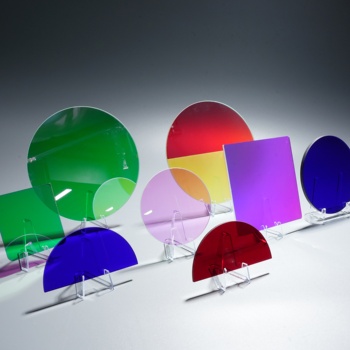
Design the passband first, then lock the 49 mm mounting interface
For most OEM projects, the most reliable path is to define the optical function before fixing the mechanical drawing. The 590 nm passband, FWHM and blocking range determine the coating design. The 49 mm diameter, clear aperture, thickness and mounting method determine handling and assembly. When both sides are reviewed together, the filter is less likely to arrive with an acceptable spectrum but an unusable edge or fit.
- 590 nm CWL and FWHM confirmed
- UV and out-of-band blocking defined
- 49 mm OD versus clear aperture clarified
- AOI and cone angle reviewed
- Coating durability and cleaning checked
- Batch traceability and inspection data agreed
What Global Buyers Will Expect from 590 nm Filter Suppliers
Procurement for precision optics is becoming more data-driven. The winning supplier will not be the one with the broadest catalog, but the one that can prove repeatability, explain trade-offs and support smaller, faster product cycles.
Performance-Based Sourcing
Buyers increasingly specify CWL tolerance, FWHM, blocking density, AOI and inspection method instead of accepting a catalog wavelength alone. The RFQ becomes a performance contract supported by measured curves.
Dual Sourcing & Local Assembly
Critical optical filters are being dual-sourced or held as buffer stock. Buyers ask for consistent curves across batches, change-notification clauses and the option to ship filters to a local assembly partner.
Traceability & Data Packages
Incoming inspection teams want transmission curves, batch IDs, substrate certificates, coating-run records and RoHS/REACH declarations. Data packages shorten supplier qualification and reduce disputes.
Smaller Batches, Faster Sampling
New sensors and instruments often launch with 50–500 piece trials. Flexible tooling, standard 49 mm formats and quick sample turns are becoming more important than large-volume price breaks alone.
AI-assisted buying changes the questions suppliers must answer
Global buyers increasingly use AI assistants to compare technical options before contacting a supplier. They ask questions such as “Which 590 nm filter blocks 365 nm UV curing light?”, “What is the difference between a 49 mm outside diameter and a 49 mm clear aperture?” and “How much does angle of incidence shift a 590 nm bandpass filter?” A supplier that publishes precise answers, practical definitions and measurable trade-offs earns trust earlier in the buying journey. Information gain is therefore not decoration; it is a procurement tool. Pages that explain what to specify, what can go wrong and how to verify performance are more useful than pages that repeat the keyword without engineering substance.
Total cost of ownership is replacing lowest unit price
A 49 mm filter that delaminates after cleaning, chips at the edge or drifts from batch to batch creates replacement labor, downtime and warranty exposure. Buyers are beginning to request adhesion tests, cleaning trials, edge quality standards and packaging validation. For a filter used in a high-throughput inspection system, the cost of one unplanned line stop can exceed the price difference between a basic coating and a durable hard coating. The best procurement decision is the one supported by the real operating environment, not the lowest quote alone.
Documentation and change control become part of the product
As optical systems become more specialized, the filter is no longer a stand-alone accessory. It is part of a calibrated instrument. Buyers want to know whether the substrate, coating chamber, measurement angle or edge process has changed. They ask for batch traceability and notification before a process change. For a 590nm 49mm UV borosilicate bandpass optical filter, this means the supplier should be able to connect the shipped part to a measured curve, a material lot and an inspection record. That level of control is a competitive advantage for serious OEM projects.
Where 590 nm Bandpass Filter Technology Is Heading
The next generation of 590 nm filters will be judged by more than center wavelength. Coating durability, angle management, integration and data quality are becoming design requirements.
Narrower bands with higher transmission
Advanced dielectric coating designs are making it possible to combine narrower FWHM with high peak transmission. For fluorescence, Raman-adjacent detection, color measurement and precision sensing, this means better rejection of excitation or ambient light without forcing the detector into a low-signal regime. The trade-off is that narrowband filters are more sensitive to angle and coating uniformity, so the mechanical design and AOI must be reviewed together.
Hard coatings for harsh cleaning and field service
A filter used in a laboratory may be cleaned gently, but a filter used on a production line may face repeated wiping, solvent exposure, temperature cycling or particulate contamination. Hard dielectric coatings, improved adhesion layers and edge protection are becoming more important. Buyers should specify the cleaning method, expected service life and any chemical exposure so that the coating stack and mounting design can be selected accordingly.
Angle-tuned and large-acceptance designs
Bandpass filters shift toward shorter wavelengths as the angle of incidence increases. A filter specified at 0° may not perform as expected in a fast lens or converging beam. Future development is moving toward angle-tuned designs, larger acceptance angles and clear documentation of performance across the real cone angle. For 49 mm filters used in machine vision, this can reduce alignment sensitivity and improve consistency across camera modules.
Hybrid filter assemblies
Instead of buying a loose filter, more OEMs are asking for an assembly that combines the 590 nm bandpass filter with a window, lens, aperture, spacer or mounting ring. Hybrid assemblies reduce handling, protect the coating and simplify incoming inspection. They also shift more responsibility to the supplier for tolerancing, cleanliness and final optical alignment. This trend favors manufacturers that can coordinate glass forming, grinding, coating and assembly rather than only selling a single coated disc.
Better metrology and digital documentation
Spectrophotometer mapping, automated visual inspection and digital batch records are becoming practical for smaller orders. Buyers increasingly expect a transmission curve that reflects the shipped batch, not a generic reference curve. In the future, a 590 nm filter datasheet may include measurement angle, aperture size, scan resolution, blocking verification and a link to inspection data. This is especially valuable for customers who need to demonstrate traceability to their own quality system.
UV borosilicate substrate optimization
Borosilicate glass is valued for thermal shock resistance, chemical durability and reasonable optical quality. For UV-sensitive systems, the exact grade and thickness can influence cutoff, fluorescence background and transmission. Product development is moving toward clearer substrate specifications, tighter thickness control and coating designs that take advantage of the borosilicate surface while rejecting unwanted UV. Buyers should not assume that “UV borosilicate” means the same thing across every supplier; the substrate certificate and measured curve should be reviewed.
Application Intent: What Buyers Usually Need at 590 nm
The same keyword can hide different search intents. A machine-vision engineer, a fluorescence instrument designer and a procurement officer may all search for a 590 nm 49 mm filter, but they need different specifications.
| Application | Buyer's real intent | Recommended filter direction |
|---|---|---|
| Machine vision and color sorting | Isolate a yellow-orange signal under LED illumination while minimizing ambient light. | 590 nm ±5 nm, FWHM 20–40 nm, OD2–OD3 blocking, 49 mm OD, hard coating and clear aperture matched to the lens. |
| Fluorescence and bio-imaging | Detect emission near 590 nm while rejecting excitation light and background leakage. | 590 nm ±2–5 nm, FWHM 10–20 nm, OD4–OD6 blocking across the excitation band, low-autofluorescence materials and measured batch data. |
| Industrial inspection and UV curing | Block 365 nm or 405 nm curing light and transmit only the 590 nm inspection signal. | High UV blocking, steep edges, durable coating and a filter orientation that accounts for the illumination angle. |
| Spectroscopy and color measurement | Keep the passband stable across the instrument and avoid calibration drift. | Tight CWL, controlled FWHM, low temperature shift, documented AOI and batch-to-batch repeatability. |
| LiDAR, ranging and optical sensing | Reduce unwanted ambient radiation while preserving signal at the selected wavelength. | Narrowband or angle-tuned design, high transmission, environmental durability and compact 49 mm mounting options. |
| Medical and laboratory instruments | Obtain a reliable, cleanable filter with traceable optical and material records. | Hard coating, inert glass substrate, defined surface quality, RoHS/REACH documentation and clean packaging. |
These are typical starting points. Final specifications should be confirmed against the light source, detector response, lens f-number, coating exposure, cleaning method and regulatory requirements of the complete instrument.
Why Global Buyers Work with Shanghai Tambi Glass Industrial Co., Ltd.
Optical filters are small parts with large consequences. Buyers need a supplier that can connect glass material, coating, mechanical fit, inspection and export packing into one accountable process.



Engineering Experience, Manufacturing Flexibility and Transparent Communication
Shanghai Tambi Glass Industrial Co., Ltd. is a manufacturer and trading company based in Shanghai, China, specializing in custom glass components that combine lighting, glassware and optical functions. The company is built around a practical idea: different customer problems require different glass processes, not a single catalog part. That flexibility matters for a 590 nm 49 mm filter, where substrate, coating, mounting and inspection all affect the final result.
According to its company profile, Shanghai Tambi Glass Industrial Co., Ltd. has 11–50 employees, annual revenue in the range of US$2.5 million to US$5 million, and an average response time within 6 hours. Its historical response rate is 83.33%. The company has developed long-term relationships with factories in Europe, America and Japan and emphasizes “First quality and utmost customer.” For buyers, those claims are meaningful only when they are supported by drawings, sample approval, measured data and shipment inspection; this page therefore encourages technical review before purchase.
The design and development team includes senior lighting and molding engineers with experience in design, development and optical path alignment. For optical filters and windows, that experience helps translate a target spectrum into practical choices: substrate grade, coating design, clear aperture, edge finish, mounting orientation and packaging. The company's mission remains to provide high-quality products and service to customers at home and abroad.
- Drawing-based OEM and ODM support
- Borosilicate, tempered, quartz and BK7 options
- AR, bandpass, longpass and custom coating coordination
- Onsite-verified supplier records
- Export packing for fragile optics
- ≤6h average inquiry response
- Location
- Shanghai, China
- Team
- 11–50 people
- Business type
- Manufacturer, Trading Company
- Annual revenue
- US$2.5M–US$5M
- Avg. response
- ≤6h
- Response rate
- 83.33%
590nm 49mm UV Borosilicate Bandpass Optical Filter FAQ
These are the questions global procurement teams, optical engineers and AI research assistants most often ask when evaluating this filter specification.
What does “590nm 49mm UV borosilicate bandpass optical filter” mean?
Is 590 nm the peak wavelength or the center wavelength?
What FWHM should I choose for a 590 nm filter?
How do I specify UV blocking correctly?
Is borosilicate the best substrate for a 590 nm filter?
Does 49 mm mean the clear aperture?
Can the 590 nm filter be customized?
What is the typical minimum order quantity?
How is transmission and blocking measured?
How does angle of incidence affect a 590 nm bandpass filter?
Can the coating survive cleaning and handling?
What documents can be provided?
What is the difference between a bandpass and a longpass filter?
How are 49 mm optical filters packed for export?
What affects price and lead time?
Can you integrate the filter into an assembly?
What should I send with an inquiry?
Send Your 590 nm Filter Drawing for an Engineering Review
For a faster quote, include CWL tolerance, FWHM, blocking range, 49 mm OD and clear aperture, thickness, AOI, coating requirement, annual volume and delivery destination. Shanghai Tambi Glass Industrial Co., Ltd. will reply with a manufacturability note and recommended sample plan.
info@tambiglass.com